
Focused Shockwave Therapy in Boston: What Ripple Patients Should Know

Have heel pain that flares on every run? An Achilles that tightens up after every WOD? A shoulder or hip that's been “almost better” for months? You're not alone. Stubborn tendon pain is one of the most common reasons athletes come to see us.
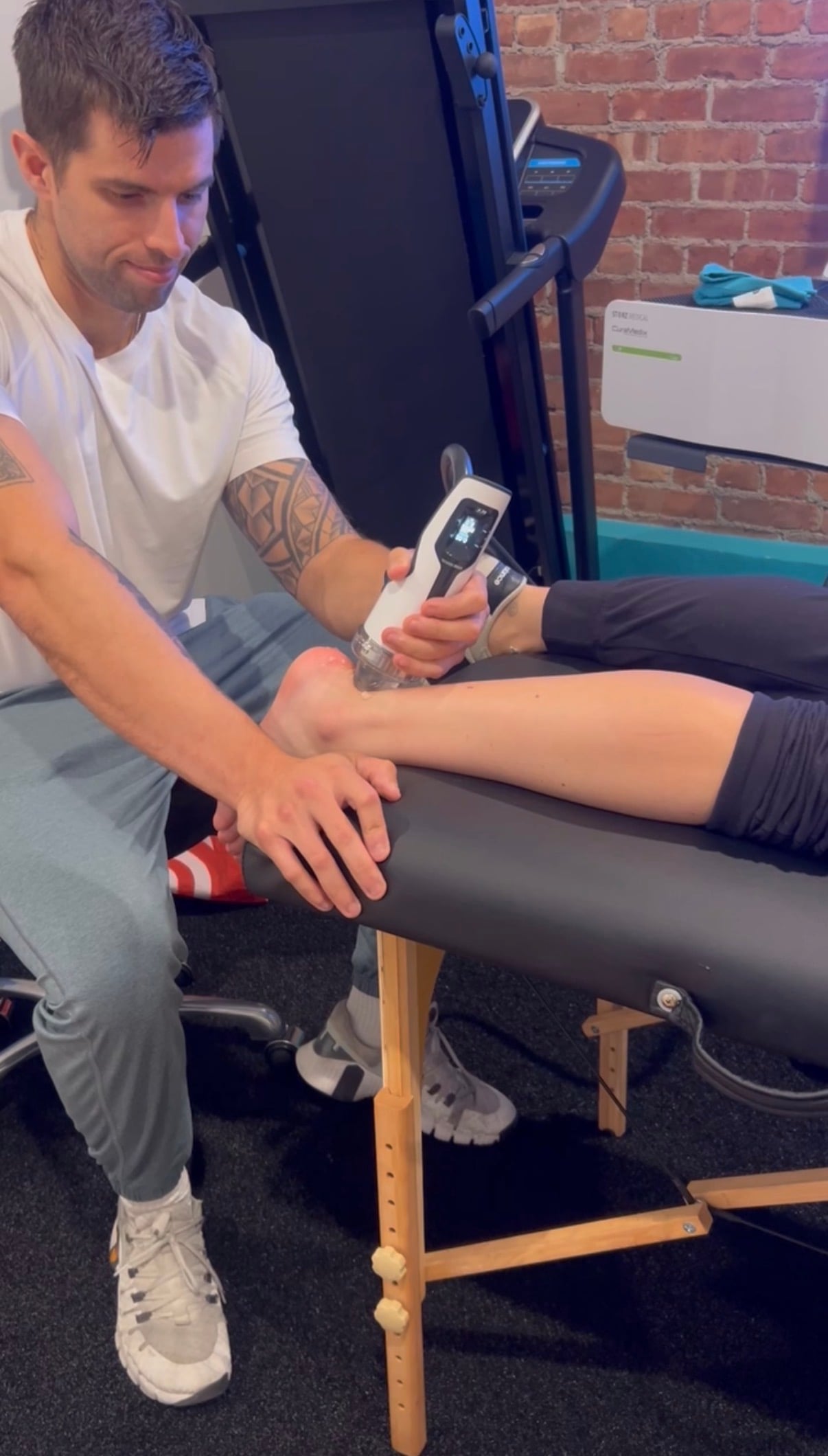
That's why we're excited to offer focused shockwave therapy at our Back Bay clinic. Here's what it is, what the research says, and how it fits into the Ripple approach.
What is shockwave therapy?
Shockwave therapy, or Extracorporeal Shockwave Therapy (ESWT), uses acoustic pressure waves to treat chronic tendon and fascia pain. Those are sound waves, not electricity. The waves pass through the skin into the irritated tissue. A session takes about 5–10 minutes, and most people complete 3–5 sessions spaced about a week apart.
How does it work?
Researchers are still working out exactly why shockwave works, but the clinical results have held up across many studies. The leading explanations:
- It restarts healing. Chronic tendon pain often means the tissue is stuck. Shockwave appears to boost blood flow and cellular activity, pushing the tendon back toward repair.
- It calms pain. Shockwave can reduce the nerve signaling that keeps long-standing pain turned up.
- It breaks up calcium. In calcific shoulder tendinopathy, shockwave helps break down the calcium deposits inside the tendon.
What does the research say?
Shockwave works best for chronic problems, meaning pain that has lasted about 3 months or more and hasn't responded to other care.
- Plantar fasciitis (heel pain): One of the best-supported uses. A randomized trial of focused shockwave found meaningful improvements in pain and function compared with placebo (Gollwitzer et al., J Bone Joint Surg Am, 2015).
- Calcific shoulder tendinopathy: Focused shockwave improved shoulder function, reduced pain, and helped resorb calcium deposits (Gerdesmeyer et al., JAMA, 2003).
- Lateral hip pain (greater trochanteric pain syndrome): Shockwave outperformed home exercise alone at longer-term follow-up (Rompe et al., Am J Sports Med, 2009).
- Achilles tendinopathy: Adding shockwave to an eccentric loading program produced better results than loading alone (Rompe et al., Am J Sports Med, 2009).
- Tennis elbow and patellar tendinopathy: Results are more mixed. Shockwave can help, but it works best as one part of a complete rehab plan.
Why focused shockwave?
Shockwave comes in two main types. Radial shockwave spreads energy outward from the skin's surface. Focused shockwave concentrates its energy at a precise depth.
Both types have research support. We chose focused shockwave for its precision: it lets us target the exact tissue that's irritated, including deeper structures like the hip and shoulder.
Shockwave opens the door. Loading walks through it.
This is the most important section of this post: shockwave is not a magic fix, and it doesn't replace strength training.
Tendons respond to load. Over time, gradually and intelligently loading a tendon is what makes it stronger, more resilient, and less painful. The Achilles research above shows this well: shockwave worked best when it was added to a loading program.
At Ripple, shockwave is always paired with an individualized strength plan delivered through your TrueCoach program. Shockwave helps calm pain and restart healing. Strength training builds a tendon that holds up to your running, lifting, and racing.
How long until I feel better?
Some people notice less pain right after a session. The bigger changes in the tissue take longer, usually building over 8–12 weeks as your body keeps adapting and your strength program progresses.
Most people keep training during treatment. Your PT may adjust your loading for a day or two after each session.
Is it safe? What are the risks?
When it's used appropriately, shockwave has a strong safety record. Common side effects are mild and short-lived: soreness, redness, or tenderness for a day or two.
We screen every patient before treatment. Shockwave isn't right for you if you:
- are pregnant
- have a blood clotting disorder or take blood thinners
- have a cancer diagnosis in the treatment area
- had a recent cortisone injection at the treatment site
Is shockwave right for me?
You may be a good fit if:
- Your tendon, heel, or hip pain has lasted 3+ months
- Rest, stretching, or injections haven't solved it
- You want to keep training while you rehab
Already a Ripple patient? Ask your PT at your next visit. New to Ripple? Book an evaluation and we'll build a plan that gets you back to doing what you love.